
5 Essential STEM Concepts Every Student Learns Through Gelato Making

Updated: Aug 8
Gelato making teaches five STEM concepts through five pieces of professional equipment: batch freezers with variable speed control demonstrate how mixing speed governs ice crystal formation, pasteurisation systems holding temperature to within 0.5°C teach heat transfer and microbiology, digital refractometers turn Brix readings into the mathematics of formulation, blast freezers with core probes produce freezing-rate data students can graph, and automated dispensing systems show engineering and statistical quality control at work. Each technology was selected on three criteria — whether students can safely operate or observe it, how many STEM principles it demonstrates, and whether it is genuinely used in production. The result is that students apply several disciplines at once to hit a measurable outcome, exactly as food scientists and process engineers do.
Discover gelato making with STEM learning in real-world applications.
Explore five innovative gelato making technologies through what is learnt in STEM education. Learn how students gain practical insights into physics and engineering through hands-on experience.
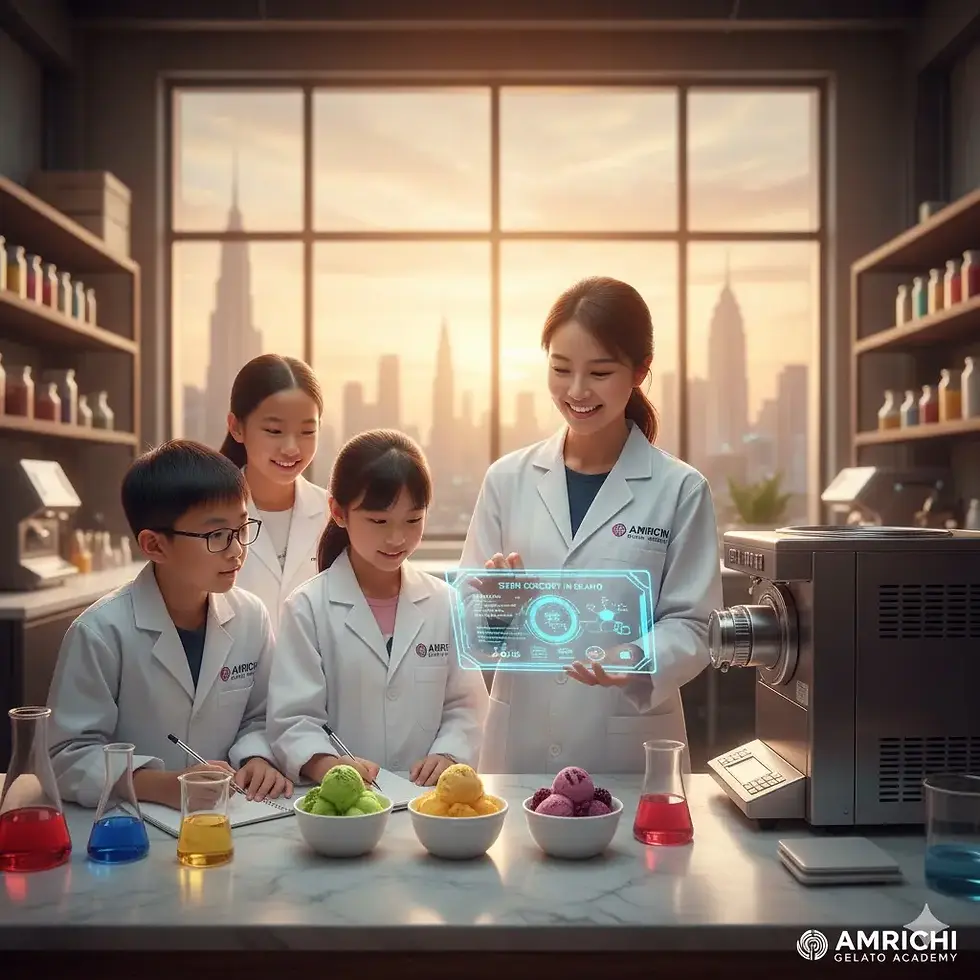
Batch freezers with variable speed control demonstrate how mixing speed affects ice crystal formation and final texture, connecting physics theory to observable outcomes.
Pasteurisation systems teach heat transfer, microbiology, and process engineering while showing how food safety depends on precise temperature control.
Digital refractometers allow students to quantify sugar content and understand how mathematics governs formulation in food production.
Blast freezers with core probes generate real-time data on freezing rates, demonstrating thermal conductivity principles students can graph and analyse.
Automated dispensing systems show how engineering solves consistency challenges and why statistics inform production quality control decisions.
1. The Reality Gap in STEM Education
Most students learn about heat transfer from textbooks. They memorise formulas for crystallisation without ever watching ice crystals form. This disconnect between theory and application explains why STEM engagement drops sharply during secondary school years.
Food production technology offers a solution that traditional lab equipment cannot match. When students operate the same batch freezers used in commercial gelato facilities, abstract physics becomes tangible. They witness emulsification in real time. They measure the precise moment when a liquid transforms into a frozen dessert.
The gelato production environment creates what educators call "productive struggle." Students must apply multiple STEM disciplines simultaneously to achieve a specific outcome. This mirrors how engineers and food scientists actually work.
2. What This Guide Delivers
This listicle examines five specific technologies used in professional gelato production. Each technology demonstrates distinct STEM principles that students encounter in their curricula. We focus on equipment that educators can access through workshop programmes, not theoretical machinery.
This is not a survey of every gelato machine on the market. We exclude consumer-grade equipment that lacks the precision controls necessary for meaningful STEM instruction. The technologies selected here offer measurable variables, repeatable processes, and clear cause-and-effect relationships that reinforce scientific method.
Educators seeking to connect classroom theory with real-world application will find concrete examples. Students exploring food science careers will understand what gelato equipment science actually involves.
3. Selection Criteria
Each technology was evaluated on three factors: educational accessibility (can students safely operate or observe it?), STEM concept density (how many principles does it demonstrate?), and industry relevance (is this equipment used in actual production?). Technologies that scored highly across all three criteria made this list.
4. Five Technologies Reshaping STEM Education Through Gelato
4.1 Batch Freezers with Variable Speed Control
Why It Matters: Most students believe freezing is a simple process: liquid gets cold, liquid becomes solid. Batch freezers with variable speed control reveal the complexity hidden in that assumption. The relationship between mixing speed and ice crystal size determines whether gelato achieves smooth texture or becomes grainy.
What It Looks Like Today: Modern batch freezers allow operators to adjust dasher rotation speeds in real time. Commercial units from manufacturers like Carpigiani display temperature curves and mixing parameters on digital interfaces. Students can observe how changing one variable affects multiple outcomes simultaneously.
How to Apply It: Challenge students to produce two batches using identical ingredients but different mixing speeds. Have them measure final texture, document crystal formation under magnification, and graph the relationship between speed and smoothness. This exercise demonstrates that food production technology requires optimisation, not just operation.
4.2 Pasteurisation Systems with Programmable Temperature Curves
Why It Matters: Pasteurisation teaches heat transfer, microbiology, and process engineering in a single operation. Students learn that food safety depends on precise temperature control over specific time intervals. This technology connects chemistry (protein denaturation) with public health outcomes.
What It Looks Like Today: Professional pasteurisers maintain temperatures within 0.5°C accuracy across programmed cycles. FDA pasteurisation standards require specific time-temperature combinations that students can verify using the equipment's data logging features.
How to Apply It: Have students calculate the thermal energy required to raise a specific volume of gelato base to pasteurisation temperature. Compare their calculations with the machine's actual energy consumption data. This bridges theoretical physics with industrial efficiency metrics.
4.3 Digital Refractometers for Sugar Content Measurement
Why It Matters: Sugar does more than add sweetness. It controls freezing point depression, affects texture, and influences shelf stability. Digital refractometers allow students to quantify sugar content precisely, demonstrating how mathematics governs formulation in food production technology.
What It Looks Like Today: Handheld digital refractometers measure Brix values (sugar concentration) within seconds. Students can test multiple samples and immediately see how ingredient ratios affect the final reading. This instant feedback accelerates the learning cycle.
How to Apply It: Provide students with a target Brix value and challenge them to achieve it by adjusting ingredient ratios. They must calculate proportions, test their formulations, and iterate until they reach the target. This exercise demonstrates that gelato equipment science requires both precision measurement and mathematical reasoning.
4.4 Blast Freezers with Core Temperature Probes
Why It Matters: Rapid freezing produces smaller ice crystals than slow freezing. This principle, central to food science, becomes observable when students track temperature changes at different depths within a gelato container. The technology demonstrates heat transfer rates and thermal conductivity in edible form.
What It Looks Like Today: Commercial blast freezers reach temperatures of -35°C to -40°C and can freeze gelato to serving temperature in under an hour. Core temperature probes allow continuous monitoring, generating data that students can graph and analyse.
How to Apply It: Insert probes at surface, mid-depth, and core positions within a gelato container. Have students predict the temperature curves for each position, then compare predictions with actual data. Discuss why the core freezes last and how container geometry affects freezing uniformity. This connects physics theory to practical STEM education benefits.
4.5 Automated Dispensing Systems with Portion Control
Why It Matters: Consistency in food production depends on precise measurement at every stage. Automated dispensing systems demonstrate how engineering solves the problem of human variability. Students learn that quality control requires both technology and process design.
What It Looks Like Today: Modern dispensing systems measure portions by weight or volume with accuracy within 2% variance. ISO standards for food manufacturing specify acceptable tolerance ranges that students can use as benchmarks for their own quality assessments.
How to Apply It: Have students manually portion ten servings, then weigh each one. Compare the variance in manual portioning with the machine's specifications. Calculate standard deviation for both methods. This exercise demonstrates why food manufacturers invest in automation and how statistics inform production decisions.
5. Connecting the Technologies
These five technologies share a common thread: they transform subjective craft into measurable science. Each piece of equipment generates data that students can analyse, graph, and interpret. Together, they demonstrate that food production operates as an integrated system where changes in one variable cascade through the entire process.
The STEM education benefits extend beyond content knowledge. Students develop comfort with industrial equipment, understand quality control principles, and recognise that food science careers combine creativity with rigorous methodology. They see that gelato equipment science is not separate from physics, chemistry, or mathematics. It is their application.
The technologies also reveal tradeoffs that professionals navigate daily. Faster freezing improves texture but increases energy costs. Higher mixing speeds incorporate more air but may damage delicate flavours. Students learn that optimisation means balancing competing priorities, not maximising single variables.
6. Where to Start
Educators planning STEM enrichment programmes should not attempt to cover all five technologies in a single session. Start with batch freezers and refractometers, which offer the clearest demonstrations of cause and effect. Add pasteurisation systems when students are ready to explore time-dependent processes.
For schools with limited budgets, partnering with facilities that already operate this equipment provides access without capital investment. Amrichi's professional gelato facility offers workshop programmes where students use commercial-grade equipment under practitioner guidance.
The goal is not to train future gelato makers. It is to show students that the science they study in classrooms shapes the food they enjoy every day. When abstract concepts become tangible outcomes, STEM engagement follows.
Frequently Asked Questions
What age groups benefit most from gelato-based STEM workshops?
Upper primary and secondary students gain the most from these programmes. They possess sufficient mathematical foundation to understand ratios and measurements while remaining open to hands-on learning experiences. The equipment complexity matches their developmental readiness for abstract thinking applied to concrete outcomes.
How does gelato making differ from typical school science experiments?
Traditional experiments often isolate single variables in controlled conditions. Gelato production requires students to manage multiple variables simultaneously, mirroring real engineering challenges. The outcome is also immediately testable through taste and texture, providing feedback that motivates iteration.
What safety considerations apply when students use industrial equipment?
Professional facilities maintain strict safety protocols including temperature warnings, guarded moving parts, and supervised operation. Students observe certain processes rather than operating equipment directly. All activities occur under guidance from practitioners trained in both production and educational delivery.
Can these STEM concepts connect to existing curriculum standards?
Yes. Heat transfer, states of matter, chemical reactions, ratios, and data analysis all appear in standard STEM curricula across Malaysia and Singapore. Educators can map workshop activities directly to learning outcomes specified in national frameworks.
How do I get my child into STEM through food science programmes?
Look for programmes that use actual production equipment rather than simplified demonstrations. Ask whether students will collect and analyse data, not just observe processes. Effective programmes connect activities to specific scientific principles and encourage students to predict outcomes before testing them.
What career pathways does food science exposure open for students?
Food science graduates work in product development, quality assurance, manufacturing engineering, and regulatory compliance. The field combines chemistry, biology, engineering, and business. Early exposure helps students understand that food production careers require rigorous scientific training.


Comments